Seedream 4.5
Drag or click to upload up JPG, PNG, or WEBP images
Sample Image
(The Created Image results will appear here)

Seedream 4.5: The Cognitive Engine for High-Aesthetic 4K Synthesis
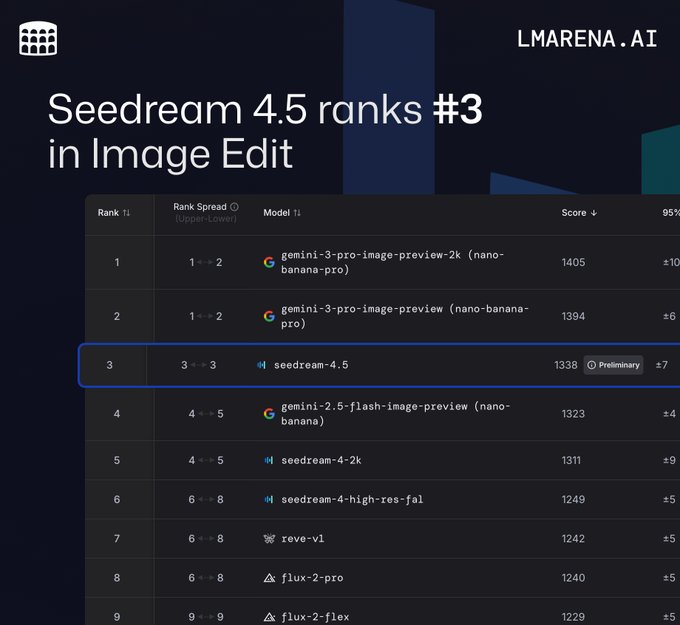
Seedream 4.5 redefines the boundaries of generative AI by merging artistic aesthetics with scientific reasoning. Unlike traditional pixel-based generators, this model utilizes advanced inference capabilities to understand physics, proportions, and spatial logic. Powered by cutting-edge optimizations like 4-bit quantization and SparseGEMM, Seedream 4.5 delivers hyper-realistic, knowledge-based visuals at native 4K resolution with unprecedented speed. It is the first AI capable of 'making the unseen visible' through cross-time simulation and flawless typographic integration.
Architecting Reality: The Seedream 4.5 Workflow
Leverage superior inference power to generate consistent, logic-driven assets in three stages:
Semantic Reasoning & Layout
Input prompts are no longer just keywords; they are logic commands. Seedream 4.5 applies knowledge-based reasoning to ensure accurate object proportions and realistic scene layouts. Whether it's technical diagrams or complex poster hierarchies, the model structurally understands where elements—including text—should exist in 3D space.
Spatiotemporal Simulation
Going beyond static image generation, the engine uses cross-time and space prediction. This ensures character stability and coherent scenes across multiple iterations. It simulates light transport and physical interactions, guaranteeing that subjects maintain their identity and details remain consistent, even when the camera angle or timeline changes.
Optimized 4K Inference
Experience the speed of sparse computing. Through 4-bit quantization and SparseGEMM optimizations, Seedream 4.5 drastically reduces generation latency. The output is a native 4K (4096px) Ultra-HD visual that is artifact-free, sharply defined, and ready for commercial deployment without the need for upscalers.
Explore Videos Created with Seedream 4.5
Watch examples of AI-generated images created with Seedream 4.5, showcasing fast 4K generation, precise edits, and style consistency.
Seedream 4.5: Technical Breakthroughs & Capabilities
Deep dive into the inference logic, stability features, and resolution capabilities of the new Seedream architecture.
How does Seedream 4.5's 'Knowledge-Based' generation differ from standard AI?
Standard AI often 'hallucinates' physics. Seedream 4.5 incorporates technical and scientific reasoning into its generation process. This means it understands how objects work, leading to accurate proportions, correct mechanical details, and realistic scene layouts that adhere to real-world logic rather than just aesthetic patterns.
Is the 4K resolution native or upscaled?
It is strictly native. Seedream 4.5 generates visuals directly at a maximum resolution of 4K (4096×4096). By utilizing inference optimizations like SparseGEMM, it achieves this high pixel density efficiently, ensuring that micro-details—like fabric weaves or distant landscapes—are generated with intentional clarity, not interpolated blur.
Can Seedream 4.5 maintain character consistency for storytelling?
Yes, this is a core upgrade. The model's cross-time and space prediction capabilities allow for 'Stable Subjects.' You can generate the same character or object across different environments and angles with high coherence, making it the ideal engine for storyboards, comics, and brand mascots.
How does it handle text and typography?
Seedream 4.5 treats text as a structural element of the image. It solves the 'gibberish' problem by rendering legible, stylistically correct typography that integrates naturally into posters and logos, respecting the lighting and texture of the scene.
What makes Seedream 4.5 faster than previous high-res models?
Speed is achieved through architectural efficiency. By implementing 4-bit quantization and SparseGEMM (General Matrix Multiply), we reduce the computational load without sacrificing quality. This allows users to iterate on complex, high-aesthetic 4K prompts significantly faster than traditional diffusion models.